A PDF reader is any software that will open a PDF file, probably the most recognizable document format in the world. Your downloadable bank statements, the newsletters from school — they're probably all in PDF format.
- Free Trial Buy Now Install Adobe Acrobat Reader DC| Mac OS. Search Acrobat Reader DC User Guide. Installing Adobe Acrobat Reader DC is a two-step process. First you download the installation package, and then you install Acrobat Reader DC from that package file. You need Mac OS X 10.9 or later to run Acrobat Reader DC. If you're running.
- Adobe Acrobat Pro DC for Mac. Adobe Acrobat Pro DC is the industry’s leading document management software for PDFs and other documents. Acrobat Pro DC comes with a host of features that Acrobat Pro does not, including PDF delivery confirmation, third-party cloud storage system integration, native conversion of Photoshop, Illustrator and InDesign files into PDFs, signature collection and more.
More and more operating systems, smartphones, and other devices contain built-in abilities to show PDF files. Even so, a dedicated PDF reader often has a number of advantages over the built-in PDF reader you may already have, like viewing options, better search, and a lot more.
Adobe Acrobat Reader DC software is the only PDF viewer. With a modern, tabbed viewing interface that allows you to view multiple documents from within the same window, and apps and tools that can enhance viewing, revising and annotating documents, you are sure to improve your workflow.
Need to edit or change a PDF file, and not just open it for reading? An easy way to do that is to convert it to Word format. If you want to make PDFs use a PDF creation app.
SumatraPDF
What We Like
Open source and lightweight.
Available in 69 languages.
What We Don't Like
No ability to edit or annotate PDFs.
No anti-aliasing, so some fonts look wonky.
SumatraPDF is an easy to use free PDF reader for Windows. While it is easy and simple to work with, it's also open for heavy customization if you so choose.
Different types of viewing modes are available, like Single Page, Facing, Book View, and Presentation. The latter view is great for distraction-free reading.
There are tons of keyboard shortcuts you can use that make it easier to move around a PDF file, which you can refer to in the SumatraPDF Manual.
You can download SumatraPDF in portable form (uses only 6 MB) or install it like a regular program.
PDFlite is another free PDF reader that's based on SumatraPDF. It looks extremely similar and works the same.
Adobe Acrobat Reader DC
What We Like
Handy drag-and-drop feature makes it easy to combine PDFs.
Excellent integration with the Adobe Cloud system.
What We Don't Like
Accessibility checker identifies problems, but it doesn't tell you how to fix them.
The free version is very limited in its features.
Adobe Systems, the creator of the PDF file format, has a free PDF reader called Adobe Acrobat Reader DC.
Tons of feature are included in Adobe Acrobat Reader DC. You can take snapshots of text and images, view a PDF in Read Mode for a more concise reading pane, and have Adobe Acrobat Reader DC read text out loud.
Adobe Acrobat Reader DC works with Windows, Mac, and Linux operating systems. The Adobe Acrobat Reader mobile app is also available for Android, Windows Phone, and iOS.
A download manager is used download Adobe Acrobat Reader DC. So while the download manager is really small in size, the actual download for the PDF reader is much larger (possibly around 50 MB).
On the Adobe Acrobat Reader DC download page, you may be asked to install McAfee Security Scan Plus and/or another program alongside Adobe Acrobat Reader DC. You must manually deselect the offer if you don't want it installed as well.
MuPDF
What We Like
Supports XPS and CBZ files as well.
Easy to use.
What We Don't Like
Interface is a little too bare bones.
Zoom feature is less than perfect.
MuPDF is a super-lightweight free PDF reader for Windows and Android.
When you launch MuPDF, you are immediately prompted to choose a PDF file before you even see the program interface. Once you have, there are literally no options to be seen but instead the full program window is dedicated to showing the PDF.
Click the top left program icon on MuPDF's title window, then select About MuPDF to see all the supported shortcut keys you can use to flip through pages, zoom in, and search for text.
When you extract the files from the download, open 'mupdf.exe' to run the program.
Expert PDF Reader
What We Like
Faster than other free options.
Intuitive interface.
What We Don't Like
Editing features are rather limited.
Tries to install other software during set up.
Expert PDF Reader is another free PDF reader for Windows.
You can view bookmarks and a list of pages found in the PDF in an easy to read index on the side of the viewing area.
There are also advanced options like signing and adding text to a PDF.
Visit CNET.com if the official download links aren't working for you.
Nuance PDF Reader
What We Like
Adding videos and images to documents is a breeze.
Dictation features makes this app ideal for the visually impaired.
What We Don't Like
No mobile version.
You can only open one PDF at a time.
Another free PDF reader for Windows 10, 8, 7, Vista, and XP is Nuance PDF Reader.
A really valuable search function is included in Nuance PDF Reader. The words you search for show up with a bit of context for easier understanding as to where the search terms are at in the text.
You can also highlight text in Nuance PDF Reader, which is great if you're using a PDF for study notes or a reference document.
PDF-XChange Editor
What We Like
Premium version is reasonably priced for what you get.
Adding and placing text is exceptionally easy.
What We Don't Like
PDFs created with the free version often include a big ugly watermark.
Doesn't automatically detect fields when creating forms.
PDF-XChange Editor is another completely free PDF reader for Windows XP and newer.
The program interface can be a bit nauseating to look at because there are buttons, toolbars, and side panels all over the place. You can easily disable most of these, though, for a much cleaner viewing experience.
In addition to opening a PDF from your own local computer, you can also enter a URL of a PDF file for PDF-XChange Editor to open (the PDF will still be downloaded, but the program does it for you).
PDF-XChange Editor also lets you add notes, record and attach audio, highlight text, attach files, and add a strikethrough to words.
Lots of features are only available in the professional version of PDF-XChange Editor, but they're clearly marked as such and aren't difficult to spot.
Evince
What We Like
Also ideal for reading comic books and power point presentations.
Excellent integration with the GNOME desktop environment.
What We Don't Like
Scrolling isn't always smooth.
The window size cannot be adjusted, and there is no full screen mode.
Evince is another free PDF reader for Windows and Linux operating systems.
The interface isn't cluttered and you can customize the toolbar with any of the included tools, like a search function and different view modes.
Evince also supports auto scroll. This is an awesome feature that lets you adjust your mouse position on the screen so as to scroll through a PDF automatically. You can fine-tune the speed for different reading paces.
Sorax Reader
What We Like
Fast and lightweight.
Doesn't even require installation.
What We Don't Like
Limited zooming options.
Doesn't come with help files.
Sorax is available for Windows as a free PDF reader.
You'll find all the basic features of a PDF reader, like the ability to search through text, copy text out of a PDF, zoom, and change the viewing mode.
Sorax also allows you to send the currently opened PDF to someone over email with the Email toolbar button.
A portable version of Sorax is available from the download page that's just around 8 MB and is available for both 32-bit and 64-bit versions of Windows.
Javelin PDF Reader
What We Like
Mobile version lets you access and manage metadata.
Advanced encryption options.
What We Don't Like
Occasional clunky performance.
The installation process is unnecessarily complicated.
Javelin PDF Reader is just that: a free PDF reader. No extra features like editing or converting litters the program interface.
Everything is super clean and easy to read and understand. The search feature isn't the best to be had, but it works well as is.
Javelin PDF Reader can launch a PDF in full screen to make reading easier, and you can just click the screen to move down the PDF pages.
The download size of Javelin PDF Reader is only 2 MB for Windows. It can also be downloaded for Macs and mobile devices like Androids and iPads.
Cool PDF Reader
What We Like
You can use it to convert PDFs to other formats including TXT, JPG, GIF, and PNG.
Command icons tell you what they do when the mouse hovers over them.
What We Don't Like
Very limited features compared to the alternatives.
The help file isn't very helpful.
At under 4 MB for the portable version, Cool PDF Reader is a free PDF reader for Windows that's light on system resources.
While Cool PDF Reader may not require much disk space, it's not the best PDF reader available. There isn't a search function and scrolling isn't the smoothest.
However, it still works as a free PDF reader if you don't like the others on this list.
You can install Cool PDF Reader to your computer or use the Standalone Package to use it without installing anything.
Adobe Acrobat Pro DC running on Windows 8. Other editions of Acrobat DC (Standard and Reader) feature a similar interface. | |||||||||||||||||||||||||
| Developer(s) | Adobe Inc. | ||||||||||||||||||||||||
|---|---|---|---|---|---|---|---|---|---|---|---|---|---|---|---|---|---|---|---|---|---|---|---|---|---|
| Initial release | June 15, 1993; 26 years ago | ||||||||||||||||||||||||
| Stable release(s)[±] | |||||||||||||||||||||||||
| |||||||||||||||||||||||||
| Preview release(s)[±] | |||||||||||||||||||||||||
| None [±] | |||||||||||||||||||||||||
| Operating system | Windows, macOS, Linux,[16]Android, iOS, BlackBerry Tablet OS, BlackBerry 10, Windows Phone | ||||||||||||||||||||||||
| Size |
| ||||||||||||||||||||||||
| Type | Desktop publishing | ||||||||||||||||||||||||
| License | Proprietary
| ||||||||||||||||||||||||
| Website | |||||||||||||||||||||||||
Adobe Acrobat is a family of application software and Web services developed by Adobe Inc. to view, create, manipulate, print and manage files in Portable Document Format (PDF).[19]
The family comprises Acrobat Reader (formerly Reader), Acrobat (formerly Exchange) and Acrobat.com. The basic Acrobat Reader, available for several desktop and mobile platforms, is freeware; it supports viewing, printing and annotating of PDF files.[20] Additional, 'Premium', services are available for reader on paid subscription. The commercialproprietary Acrobat, available for Microsoft Windows and macOS only, can also create, edit, convert, digitally sign, encrypt, export and publish PDF files. Acrobat.com complements the family with a variety of enterprise content management and file hosting services.
- 1History
- 2Internationalization and localization
- 3Security
History[edit]
Adobe Acrobat came to being in 1993 and had to compete with other products and proprietary formats that aimed to create digital documents:
- Common Ground from No Hands Software Inc.[21]
- Envoy from WordPerfect Corporation
- Folio Views from NextPage
- Replica from Farallon Computing[22]
- WorldView from Interleaf[23]
- DjVu from AT&T Laboratories
Acrobat Dc Mac
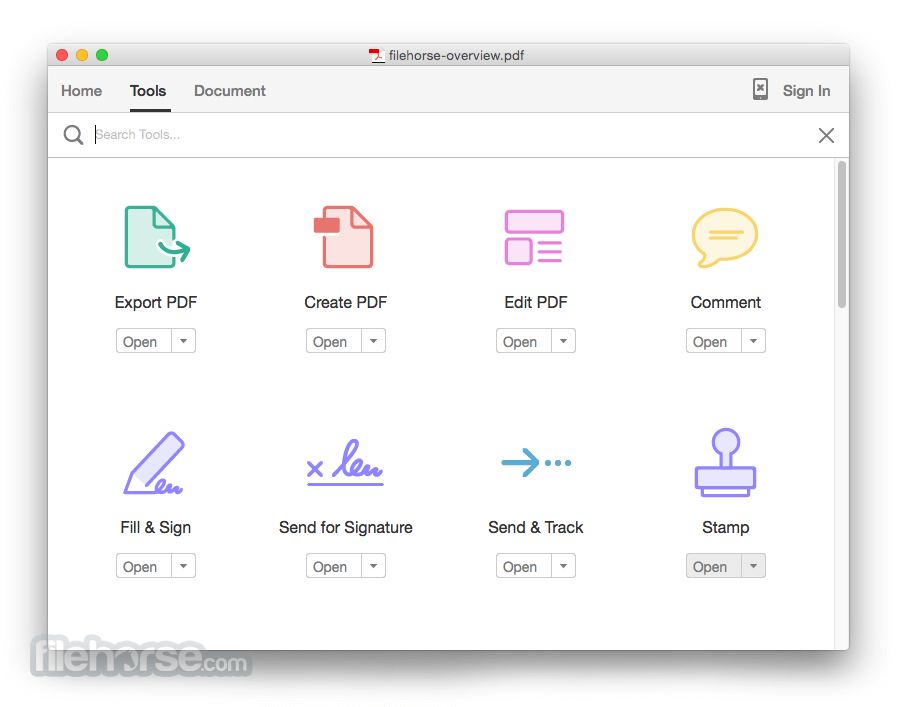
Adobe has renamed the Acrobat products several times, in addition to merging, splitting and discontinuing them. Initially, the offered products were called Acrobat Reader, Acrobat Exchange and Acrobat Distiller. 'Acrobat Exchange' soon became 'Acrobat'. Over time, 'Acrobat Reader' became 'Reader'. Between versions 3 and 5, Acrobat did not have several editions.[clarification needed] In 1999, the Acrobat.com service came to being and introduced several web services whose names started with 'Acrobat', but eventually, 'Acrobat.com' was downgraded from the name of the family of services, to that of one those service.
By 1 April 2015, the Acrobat family consisted of:[24]
- Acrobat XI Pro (for Windows and macOS)
- Acrobat XI Standard (for Windows only)
- Reader XI (for Windows, macOS, Android and iOS)
- FormsCentral (web service with desktop client)
- EchoSign (web service)
- Acrobat.com (web service)
- PDF Pack (web service)
- Send (web service)
Unlike most other Adobe products, such as members of Adobe Creative Suite family, the Acrobat products do not have icons that display two letters on a colored rectangle.
Document Cloud[edit]
In April 2015, Adobe introduced the 'Document Cloud' branding (alongside its Creative Cloud) to signify its adoption of the cloud storage and the software as a service model. Apps under this branding received a 'DC' suffix. In addition, 'Reader' was renamed back to 'Acrobat Reader'.[25][26] Following the introduction of Document Cloud, Acrobat.com was discontinued as their features were integrated into the desktop and mobile apps.
The UI had major changes with the introduction of Acrobat DC in 2015, which supports Windows 7 and later, and OS X 10.9 and later. Version numbers are now identified by the last two digits of the year of major release, and the month and year is specified; the previous version was 12, but examples of the DC (Document Cloud) Acrobat product family versions are DC June 2016, version 15.016.20045, released 2 June 2016 and DC Classic January 2016, version 15.006.30119, released 12 January 2016.[27] From DC 2015 the Acrobat family is available in two tracks, the original track, now named Classic, and the Continuous track.[28] Updates for the Classic track are released quarterly, and do not include new features, whereas updates for the Continuous track are issued more frequently, and implemented silently and automatically.[29]
The last pre-DC version, Acrobat XI, was updated to 11.0.23 version (and this was the final release[30]) on November 14, 2017,[31] support for which ended on October 15, 2017.[32]
As of August 2018, the main members of the Acrobat family include:[33]
- Acrobat Pro DC (for Windows and macOS)
- Acrobat Standard DC (for Windows only)
- Acrobat Reader DC (for Windows, macOS, Android, iOS and Windows Phone)
- Fill & Sign (for Android or iOS)
- Sign (for Android or iOS)
- Scan (for Android or iOS)
- Document Cloud (web service with desktop clients)
Internationalization and localization[edit]

Language availability[edit]
Adobe Acrobat is available in the following languages: Arabic, Chinese Simplified, Chinese Traditional, Czech, Danish, Dutch, English, Finnish, French, German, Greek, Hebrew, Hungarian, Italian, Japanese, Korean, Norwegian, Polish, Portuguese, Romanian, Russian, Spanish, Swedish, Turkish and Ukrainian. Arabic and Hebrew versions are available from WinSoft International,[34]Adobe Systems' internationalization and localization partner.
Specific features for Arabic and Hebrew languages[edit]
The Arabic and Hebrew versions are developed specifically for these languages, which are normally written right-to-left. These versions include special TouchUp properties to manage digits, ligatures option and paragraph direction in right-to-left Middle Eastern scripts such as Arabic, Hebrew, and Persian, as well as standard left-to-right Indian scripts such as Devanagari and Gujarati. The Web Capture feature can convert single web pages or entire web sites into PDF files, while preserving the content's original text encoding. Acrobat can also copy Arabic and Hebrew text to the system clipboard in its original encoding; if the target application is also compatible with the text encoding, then the text will appear in the correct script.
Security[edit]
A comprehensive list of security bulletins for most Adobe products and related versions is published on their Security bulletins and advisories page and in other related venues.[35][36] In particular, the detailed history of security updates for all versions of Adobe Acrobat has been made public.[37]
From Version 3.02 onwards, Acrobat Reader has included support for JavaScript. This functionality allows a PDF document creator to include code which executes when the document is read. Malicious PDF files that attempt to attack security vulnerabilities can be attached to links on web pages or distributed as email attachments. While JavaScript is designed without direct access to the file system to make it 'safe', vulnerabilities have been reported for abuses such as distributing malicious code by Acrobat programs.[38] Adobe applications had already become the most popular client-software targets for attackers during the last quarter of 2009.[39]McAfee predicted that Adobe software, especially Reader and Flash, would be the primary target for software attacks in the year 2010.[40]
September 2006 warning[edit]
Adobe Acrobat Reader For Mac
On September 13, 2006, David Kierznowski provided sample PDF files illustrating JavaScript vulnerabilities. Since at least version 6, JavaScript can be disabled using the preferences menu[41] and embedded URLs that are launched are intercepted by a security warning dialog box to either allow or block the website from activating.[42]
February 2009 warning[edit]
On February 19, 2009, Adobe released a Security Bulletin announcing JavaScript vulnerabilities in Adobe Reader and Acrobat versions 9 and earlier.[43] As a workaround for this issue, US-CERT recommended disabling JavaScript in the affected Adobe products, canceling integration with Windows shell and web browsers (while carrying out an extended version of de-integration for Internet Explorer), deactivating Adobe indexing services and avoiding all PDF files from external sources.[44]
February 2013 warning[edit]
Adobe has identified critical vulnerabilities in Adobe Reader and Acrobat XI (11.0.01 and earlier) for Windows and Macintosh, 9.5.3 and earlier 9.x versions. These vulnerabilities could cause the application to crash and potentially allow an attacker to take control of the affected system. There have been reports of these vulnerabilities being exploited to trick Windows users into clicking on a malicious PDF file delivered in an email message. Adobe recommended users update their product installations.[45]
January 2016 warning[edit]
Adobe has released security updates for Adobe Acrobat and Reader for Windows and Macintosh. These updates address critical vulnerabilities that could potentially allow an attacker to take control of the affected system.[46][47]
See also[edit]
Download Dc For Mac
References[edit]
- ^ abcde'Overview — Acrobat and Adobe Reader DC Release Notes'. Adobe Systems. 2019-08-22.Cite journal requires
|journal=(help) - ^'19.010.20069 Out of cycle update, January 03, 2019 — Acrobat and Adobe Reader Release Notes'. Adobe Systems. 2019-01-03.Cite journal requires
|journal=(help) - ^'17.011.30105 Planned update, October 02, 2018 — Acrobat and Adobe Reader Release Notes'. Adobe Systems. 2018-10-02.Cite journal requires
|journal=(help) - ^'17.011.30105 Planned update, October 02, 2018 — Acrobat and Adobe Reader Release Notes'. Adobe Systems. 2018-10-02.Cite journal requires
|journal=(help) - ^'19.010.20069 Out of cycle update, January 03, 2019 — Acrobat and Adobe Reader Release Notes'. Adobe Systems. 2019-01-03.Cite journal requires
|journal=(help) - ^'15.006.30244 Optional update, November 03, 2016 — Acrobat and Adobe Reader Release Notes'. Adobe Systems. 2016-11-02.Cite journal requires
|journal=(help) - ^Adobe Systems. 'Adobe Reader'. Google Play. Google Inc. Retrieved 2018-11-02.
- ^Adobe Systems. 'Adobe Reader'. App Store. Apple. Retrieved 2016-12-18.
- ^'Adobe Reader Windows Store page'. Microsoft Store. Microsoft. Retrieved 2013-06-27.
- ^'Adobe Reader Touch for Windows 8 adds Comments and More'. Engineering blog for Adobe Reader on mobile platforms. Adobe Systems. 2013-02-01. Retrieved 2013-03-07.
- ^Adobe Systems. 'Adobe Acrobat Reader'. Windows Store. Microsoft.
- ^'FTP download of Adobe Reader for Linux'. ftp. Adobe Systems. Retrieved 2013-05-15.
- ^'Adobe - Security Bulletins: APSB13-15 - Security updates for Adobe Reader and Acrobat'. Adobe Systems. Retrieved 2015-11-26.
Release date: May 14, 2013; Last updated: August 8, 2013; Vulnerability identifier: APSB13-15
- ^'Security Advisory for Adobe Flash Player, Adobe Reader and Acrobat'. Adobe Systems. Retrieved 2018-04-19.
Release date: October 28, 2010; Last updated: November 16, 2010; Vulnerability identifier: APSA10-05
- ^'Update available for vulnerabilities in versions 7.0.8 and earlier of Adobe Reader and Acrobat'. Adobe Systems. Retrieved 2018-05-21.
Release date: January 9, 2007; Last updated: January 16, 2007; Vulnerability identifier: APSB07-01
- ^'Download new and previous versions of Adobe Reader'. Adobe.com. Adobe Systems. Retrieved 29 July 2013.
- ^'Adobe – Adobe Reader download – All versions'. adobe.com. Adobe Systems. Retrieved 29 July 2013.
- ^'Download a free trial of Acrobat XI Pro'. Adobe.com. Adobe Systems. Retrieved 29 July 2013.
- ^'Adobe Acrobat family'. 2008. Archived from the original on 19 January 2008. Retrieved 19 January 2008.Cite uses deprecated parameter
|deadurl=(help) - ^'Adobe Reader'. 2008. Archived from the original on 18 January 2008. Retrieved 19 January 2008.Cite uses deprecated parameter
|deadurl=(help) - ^Borzo, Jeanette (14 June 1993). 'Paperless: Tools resurrect hope for paperless office concept'. InfoWorld. 15 (24). ISSN0199-6649.
- ^Eckerson, Wayne (26 July 1993). 'Farallon gives Adobe Acrobat run for money'. Network World. International Data Group. 10 (30): 86. ISSN0887-7661.
- ^Jarrin, Christopher (22 July 1996). 'Reading what you sow'. InfoWorld. 18 (30): 66. ISSN0199-6649.
- ^'Acrobat XI Pro FAQ'. adobe.com. Adobe Systems. Archived from the original on 1 April 2015.
- ^Heller, Martin (April 9, 2015). 'Review: Adobe Acrobat polishes its act'. InfoWorld. Retrieved 28 March 2016.
- ^Frank, Blair Hanley (October 13, 2015). 'Adobe teams up with Dropbox as part of Document Cloud upgrades'. IDG News Service. Retrieved 28 March 2016.
- ^'Release Notes - Acrobat, Reader'. Acrobat Help. Adobe Systems.
- ^'Document Cloud Product Tracks — Enterprise Administration Guide'. Adobe.com. Retrieved 27 June 2016.
- ^https://www.adobe.com/devnet-docs/acrobatetk/tools/AdminGuide/whatsnewdc.html
- ^'Adobe Security Bulletin'. helpx.adobe.com. Retrieved 2017-11-30.
- ^'11.0.23 Planned update, November 14, 2017 — Acrobat and Adobe Reader Release Notes'. www.adobe.com. Retrieved 2017-11-30.
- ^'Adobe Support Policies: Supported Product Versions'. Adobe. 2016. Retrieved 20 October 2016.
- ^'Adobe Acrobat DC FAQ'. helpx.adobe.com. Adobe Systems. Retrieved 20 August 2018.
- ^'Adobe Acrobat Professional software – Communicate and collaborate with the essential PDF solution, enhanced features for Central and East European and Middle Eastern users'. Winsoft-international.com. Archived from the original on 31 August 2010. Retrieved 4 December 2010.Cite uses deprecated parameter
|deadurl=(help) - ^'Security Bulletins and Advisories'. adobe.com. Adobe Systems.
- ^'Adobe PDF Security Issues, Acrobat Vulnerabilities, PDF Cracks'. Locklizard.
- ^'Security Bulletins and Advisories – Adobe Acrobat'. adobe.com. Adobe Systems.
- ^Brockmeier, Joe (30 March 2005). 'Unexpected features in Acrobat 7'. LWN.net. Eklektix. Retrieved 20 February 2009.
- ^'McAfee Threats Report: Fourth Quarter 2009'(PDF). McAfee Avert Labs. February 2010. p. 16. Archived from the original(PDF) on 15 February 2010. Retrieved 9 May 2010.Cite uses deprecated parameter
|deadurl=(help) - ^'2010 Threat Predictions'(PDF). McAfee Labs. December 2009. p. 2. Archived from the original(PDF) on 2 June 2010. Retrieved 9 May 2010.Cite uses deprecated parameter
|dead-url=(help) - ^Naraine, Ryan (28 April 2009). 'Adobe: Turn off JavaScript in PDF Reader'. ZDNet. CBS Interactive.
- ^Naraine, Ryan (15 September 2006). 'Hacker Discovers Adobe PDF Back Doors'. eWeek. Ziff Davis Enterprise Holdings Inc. Retrieved 5 August 2011.
David Kierznowski, a penetration testing expert specializing in Web application testing, has released proof-of-concept code and rigged PDF files to demonstrate how the Adobe Reader program could be used to initiate attacks without any user action.
- ^'Security Updates available for Adobe Reader and Acrobat versions 9 and earlier'. adobe.com. Adobe Systems. 19 February 2009. Retrieved 11 August 2013.
- ^'Vulnerability Note VU#905281'. US-CERT. 20 February 2009. Archived from the original on 23 February 2009. Retrieved 20 February 2009.Cite uses deprecated parameter
|deadurl=(help) - ^'Security Advisory for Adobe Reader and Acrobat'. Adobe Systems.
- ^'Security Advisory for Adobe Reader and Acrobat'. Adobe Systems.
- ^'Adobe Releases Security Updates for Acrobat, Reader, and Digital Editions'. United States Computer Emergency Readiness Team.
External links[edit]
| Wikimedia Commons has media related to Adobe Acrobat. |
ref>'Adobe Acrobat DC FAQ'. helpx.adobe.com. Adobe Systems. Retrieved 20 August 2018.